

Every organization celebrates scale as a marker of success. More users, more data, more features, it’s the visible proof that digital transformation is working. Yet behind every successful scaling story lies a quiet tension: as systems expand, costs rise faster than the business value they create. Infrastructure grows, services multiply, and complexity compounds. What once felt like efficiency now feels like entropy.
The paradox of scale is not new. Cloud promised elasticity, but in practice, elasticity without architectural understanding simply expands waste faster. Engineering teams build for resilience, finance teams tighten budgets, and product managers push for velocity. Each team acts rationally within its domain, yet collectively, the system becomes opaque. When costs surge, no one can answer the simplest question: why?
The answer lies not in more dashboards or granular cost reports, but in understanding the architecture itself. How design decisions sometimes made years earlier create cost behaviors that persist long after their rationale fades. This is where the concept of Architectural Intelligence becomes transformative. In the previous article, we explored the foundational pillars of Architectural Intelligence. In this post, we will deep dive into the illusion of successful scaling and how Architectural Intelligence can help you overcome that.
The illusion of successful scaling
Scaling often begins as a success story. A new feature gains traction, traffic surges, and the system handles the load without breaking. To the untrained eye, everything appears to be working as intended. But beneath that success, something subtle happens: each new replica, each new API call, and each new service dependency begin to alter the system’s cost structure.
Cloud infrastructure amplifies this illusion. Because capacity can be provisioned instantly, scaling appears effortless. Compute scales with traffic, storage expands automatically, and managed services offload operational burden. What it doesn’t offload, however, is financial responsibility.
Most organizations discover the hidden cost of scaling only when the bill arrives. A database cluster doubles its cost due to cross-region traffic. A microservice refactor increases the data transfer footprint tenfold. A new AI-powered feature adds an unpredictable line item for third-party API usage. None of these costs are visible during design. They only surface when the scale is achieved too late to adjust.
Scaling is not just a question of handling more load. It is a question of how that load propagates through architecture. Without understanding dependencies, replication patterns, and ownership, every act of scaling is an act of faith.
Architecture as the silent cost driver
Most cloud cost optimization efforts treat expenses as line items to trim unused volumes, over-provisioned instances, and idle clusters. But these symptoms are byproducts of deeper architectural causes.
Architecture dictates cost. Consider two identical workloads, one running as a tightly coupled monolith and another decomposed into dozens of microservices. The microservices architecture offers agility and independent scaling, but it also introduces latency, cross-service data transfer, and orchestration overhead. Each interaction, each function invocation, and each redundant deployment adds to the cumulative cost.
The architecture itself, not just the usage, encodes cost behavior.
- Service granularity affects network and compute cost.
- Deployment topology affects data transfer charges.
- Resilience patterns (like multi-region failover) affect idle utilization.
- Integration design affects how many times data moves across boundaries.
Without architectural context, optimization efforts resemble pruning branches while the roots continue to grow unchecked. You might reduce instance sizes or automate shutdowns, but the underlying cost patterns driven by design remain untouched.
Architectural Intelligence reframes cost not as a financial artifact but as a structural property of design. Mapping dependencies and relationships reveals why a service is expensive, not just that it is.
Identify design trade-offs before they become painful
- Modeling cost as a design constraint
One of the most expensive costs in architecture are those that are discovered too late. By the time a system reaches scale, patterns are entrenched, and refactoring is prohibitively costly.
Architectural Intelligence allows organizations to explore design trade-offs before they hit production. By overlaying cost and performance data on top of architectural models, teams can simulate “what if” scenarios with precision:
- What would be the cost delta between a monolithic and microservices approach?
- How would moving from EC2 to serverless change utilization and spend?
- What is the financial impact of multi-region deployment versus single-region redundancy?
These are not speculative questions; they are architectural realities that shape long-term cost trajectories. With a living architectural map, engineers can model the cascading effect of design choices. They can see how a new feature interacts with existing systems, which dependencies it introduces, and what incremental cost it adds. Finance teams can evaluate proposed architectures through the lens of ROI. Product teams can prioritize features not just by value, but by cost sustainability. This transforms cost from a reactive concern into a proactive design dimension.
- Make cost a first-class citizen
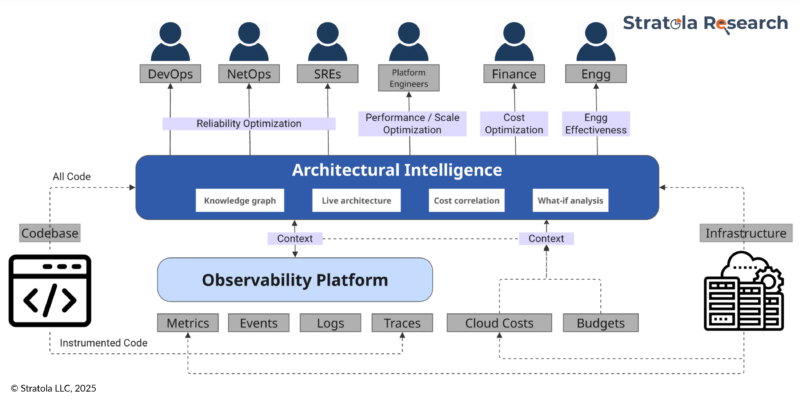
Architectural Intelligence redefines enterprise visibility by fusing cost awareness directly into the architecture itself. It is not another monitoring or financial tool it is a semantic layer that unifies them.
At its core, Architectural Intelligence builds a living system map a continuously updated knowledge graph capturing relationships among services, databases, APIs, teams, and infrastructure. Each node carries attributes such as cost, performance, utilization, and ownership. Each edge represents dependencies, data flows, and architectural intent.
This model makes questions that once required weeks of cross-team analysis answerable in seconds:
- “Which services contribute most to data transfer charges?”
- “Which team owns the workloads driving GPU costs?”
- “If we deprecate this API, which downstream systems will be affected?
By linking cost data with architectural context, decisions gain dimensionality. Engineers no longer need to choose between speed and efficiency in the dark they can visualize how each decision ripples across cost and reliability dimensions. Architectural Intelligence elevates cost from an afterthought to a governance principle embedded in architecture itself.
- From scaling blindly to scaling intelligently
Most organizations approach scaling reactively: when systems strain, they add resources; when bills grow, they start cost-cutting. This oscillation between over-provisioning and austerity creates instability and friction.
Scaling intelligently means understanding why a system scales the way it does. Architectural Intelligence enables this by correlating cost with design and performance.
- Hotspot Analysis: Identify services that consume disproportionate resources relative to their usage.
- Cost-Aware Monitoring: Integrate cost metrics into observability dashboards, so performance gains can be evaluated against their financial impact.
- Anomaly Detection: Recognize when new patterns, like an AI feature or external API integration, introduce cost anomalies inconsistent with usage growth.
When engineers investigate incidents or propose improvements, they see both performance and cost consequences. Decisions are no longer made in isolation. This alignment turns scaling from a blind process into an architected discipline, one that weighs cost, reliability, and value as peers.
The Organizational Shift: From cost policing to contextual decision-making
Historically, cost management has been reactive, and punitive teams are asked to “cut 10%” without understanding the implications. Architectural Intelligence shifts this conversation.
Instead of financial policing, it enables contextual governance. Every team can see how their systems contribute to overall spend and performance. The cost of redundancy can be justified by reliability; the expense of AI inference can be mapped to customer value.
This fosters shared accountability. Engineering managers can allocate budgets based on architectural complexity rather than headcount. FinOps teams can explain costs in terms of design choices, not just billing categories. Product teams can quantify trade-offs between feature growth and cost exposure. When architecture becomes the lingua franca between finance and engineering, organizations move from adversarial budgeting to collaborative optimization.
The future of cost-aware architecture
Architectural Intelligence does more than visualize the present; it lays the foundation for autonomous optimization. As the living system map matures, AI models can begin reasoning about architecture just as human architects do, recognizing patterns, forecasting cost impacts, and suggesting optimizations.
Imagine an environment where:
- An AI agent detects a performance degradation, traces it to a specific service, models three potential fixes, and presents the most cost-effective option.
- A planning system simulates the cost implications of introducing a new AI model before it is deployed.
- Continuous optimization systems make incremental adjustments daily, right-sizing resources, co-locating services, and rebalancing costs automatically.
These scenarios depend on one prerequisite: a machine-readable understanding of architecture and cost relationships. Architectural Intelligence provides precisely that. It transforms static documentation into an active reasoning layer that both humans and machines can use to manage complexity. In this future, scaling is no longer a leap of faith; it’s a calculated, continuous negotiation between growth, performance, and cost.
Lessons for modern architects
Architects sit at the intersection of technology, business, and operations. Their role is no longer limited to ensuring performance or resilience; they are now responsible for designing cost behavior itself. Architectural Intelligence augments this responsibility with tools that make trade-offs visible and quantifiable. It allows architects to:
- Visualize the total cost of design before implementation.
- Identify redundant or inefficient patterns early.
- Communicate the financial impact of architectural choices to non-technical stakeholders.
The discipline of architecture becomes evidence-based rather than intuition-driven. Instead of post-mortems after budget overruns, organizations can conduct pre-mortems evaluating designs through the lens of cost and sustainability. The hidden cost of scaling is not inevitable; it is a visibility problem. Architectural Intelligence turns that visibility into foresight.
Conclusion: Designing for scale
Scaling is the ultimate test of architecture. It reveals not only how systems perform but how they were conceived. Every inefficient data flow, every redundant dependency, every unnecessary abstraction eventually shows up as cost. Traditional cost optimization treats this as a financial problem. But in truth, it is an architectural one. The only way to control costs sustainably is to understand its architectural origins.
Architectural Intelligence offers that understanding. It creates a shared, living model of how systems behave technically, financially, and organizationally. It allows enterprises to see cost not as a constraint, but as a design parameter that can be optimized alongside performance and reliability.
In doing so, it changes the very definition of scaling. Scaling is no longer about handling more traffic or users. It is about doing so intelligently with architecture, cost, and business value in harmony. The hidden cost of scaling is real, but it is not unmanageable. With Architectural Intelligence, enterprises gain the one capability they’ve always lacked: the ability to see, in real-time, how architecture drives costs and how intelligent design can reverse that equation.

Leave a Reply