
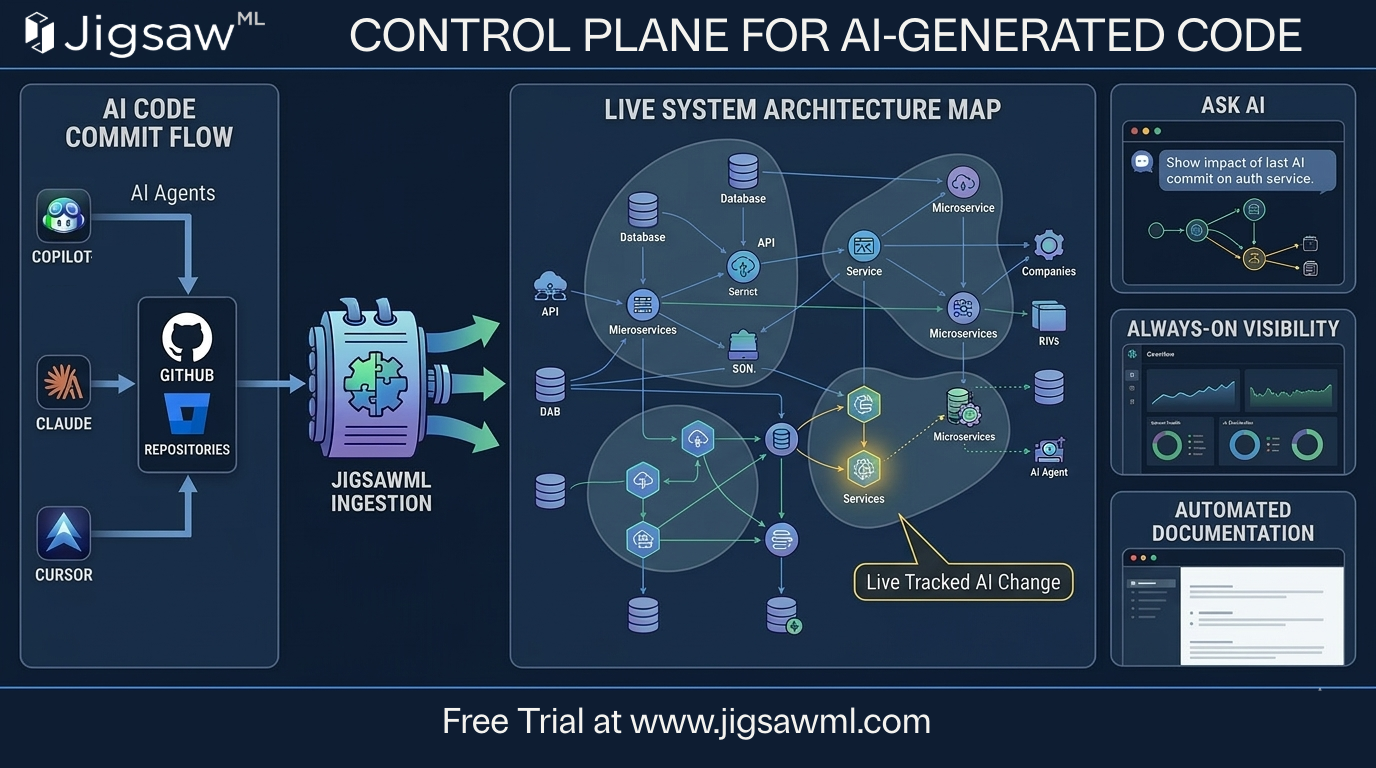
Today, I am incredibly proud to announce the general availability of JigsawML, the control plane built for the AI coding era. Starting now, engineering teams everywhere can use JigsawML to automatically generate interactive, continuously updated architecture diagrams from their codebases, giving them the visibility and control they need to understand what AI agents are building on their behalf. You can start a free trial today at www.jigsawml.com.
This is a moment our team has been working toward since we founded JigsawML, and I want to use this post to explain why we built this, what problem it solves, and who it is built for.
The Problem Nobody Wants to Say Out Loud
AI is writing a lot of code. If you have been anywhere near a development team recently, you already know this firsthand. Pull requests spanning hundreds of files. Entire features materializing before lunch. Code reviews that would have taken a week are now landing the same afternoon.
The numbers confirm what every engineering leader is quietly observing. In 2025, 41% of all code written globally is AI generated or AI assisted. Looking at data from approximately 4.2 million developers tracked between November 2025 and February 2026, AI-authored code now makes up 26.9% of all production code, up from 22% the prior quarter. Lines of code per developer grew from 4,450 to 7,839 as AI coding tools act as a force multiplier.
The industry has celebrated all of this, and rightfully so. AI is delivering genuine productivity gains, and the world has an enormous appetite for more software. But there is a question that has gone largely unasked in all the excitement: if AI is writing the code, who actually understands the system?
That is the problem we built JigsawML to solve.
What Happens on Day 2
Day 1 is creation. You ship the feature. The PR merges. The sprint closes green. Day 2 is everything that follows: the maintenance, the incident at two in the morning, the new engineer trying to onboard into a codebase that has been evolving at machine speed, the compliance audit that asks you to map your data flows, the architectural decision that turns out to have consequences nobody anticipated because nobody had visibility into the system when the code was committed.
AI code assistants excel at adding code quickly, but they can cause what we would call “AI-induced tech debt.” Code churn, defined as the percentage of code discarded within two weeks of being written, is increasing dramatically across dev teams, creating substantial risks for teams deploying to production environments.
The documentation problem makes this worse. Traditional architecture diagrams are drawn once, usually for an important meeting or an onboarding session, and then they go stale the moment the system changes. In a world where AI is modifying your codebase continuously, a diagram that was accurate on Monday is misleading by Wednesday. And a misleading diagram is worse than no diagram at all.
This is the visibility crisis at the center of the AI coding era. Developers are committing AI-written code without fully understanding its architectural implications. Engineering leaders struggle to grasp what their teams are building. DevOps teams troubleshoot systems that evolve faster than any documentation can keep pace with.
Why This Problem Is Unsolvable Without AI
Here is what makes the visibility gap so difficult to close through conventional means: creating a meaningful architecture diagram has always required human judgment. A senior engineer looks at a complex system, decides what matters, and distills it into something another person can understand quickly. That act of synthesis, of deciding what to surface and what to suppress, is the entire value of the diagram. You cannot automate it with a script or a parser.
Until now, that was true.
Large language models change the equation entirely. For the first time, we have AI systems capable of parsing a codebase, understanding intent, and making the same kinds of judgment calls that an experienced architect would make standing at a whiteboard. An LLM can look at a codebase and reason: this service is the critical one, these three are tightly coupled, that one is a utility that does not need to be front and center.
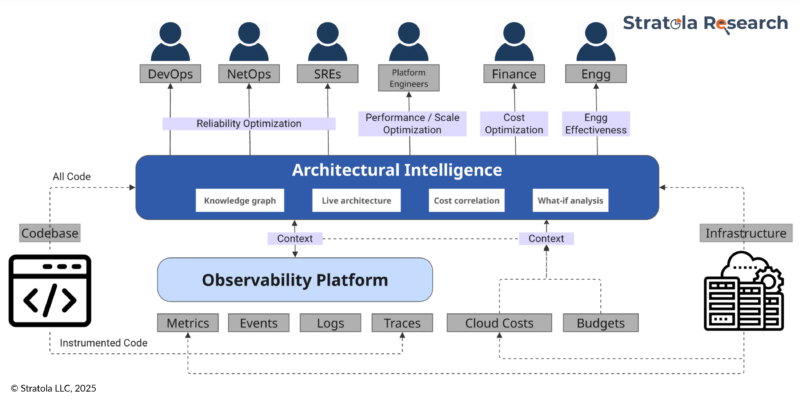
That is what Architectural Intelligence actually means. Not just drawing boxes from code, but understanding which boxes matter to the human looking at them. Dinesh Chandrasekhar, Chief Analyst at Stratola, defined this concept in his October 2025 research report as establishing a living, queryable model of enterprise architecture that connects all the fragmented pieces of visibility into a unified semantic layer. JigsawML is the operational embodiment of that concept.
However, this is not something a chatbot alone can do. It requires a careful combination of deterministic software analysis – parsing, dependency mapping, graph construction – with the reasoning capabilities of large language models. That combination is what makes Architectural Intelligence possible, and it is why we built a platform to deliver it.
What JigsawML Does
JigsawML automatically ingests your codebase and generates interactive architecture diagrams that update in real time as code changes. Every commit is tracked. Every dependency is mapped. The system evolves with your software rather than falling behind it.
The platform connects directly to public and private code repositories including GitHub and Bitbucket, and supports local installations for organizations with strict data governance or security requirements.
Three capabilities define the platform:
Always-on architectural visibility. JigsawML continuously monitors your repositories and reflects every change in your architecture diagram as it happens. You always have an accurate picture of your system, not the picture that was accurate three sprints ago.
Natural language querying through AskAI. Engineers can talk to their architecture directly. Ask which services depend on a given database. Ask what changed in the payment flow this week. Ask where a particular API is consumed across the system. AskAI answers in the context of your live architecture, not a static snapshot.
Automated documentation that stays current. JigsawML generates and maintains comprehensive documentation of your software architecture, with intelligent feedback on the structural implications of recent changes. Your documentation is no longer a project you do once and forget.
Who This Is Built For
We designed JigsawML for the engineering teams that are already living in the AI coding era, not the ones waiting to arrive.
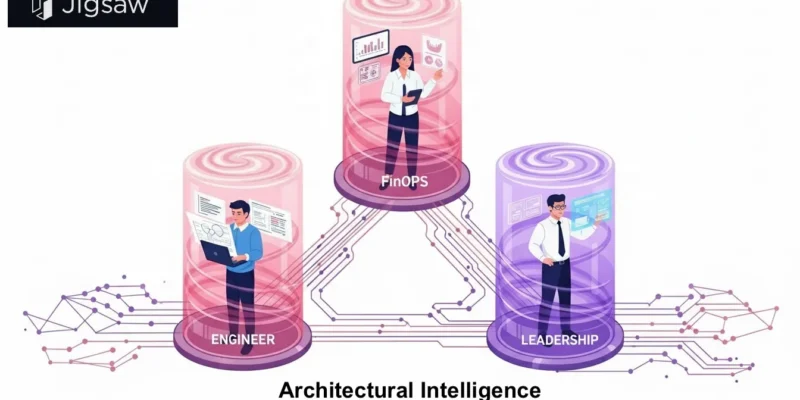
For the engineering leader, JigsawML answers a question that has become genuinely unanswerable without it: what is my team building right now, and how does it connect to everything else? As AI coding tools extend the reach of every developer on your team, the answer to that question becomes simultaneously harder to obtain and more critical to have.
For the DevOps and platform engineer, JigsawML closes the gap between what gets deployed and what gets understood. When an incident occurs, being able to pull up a live architecture diagram and trace the chain of change compresses hours of diagnosis into minutes. Think of it the way you would think about Google Earth: you do not see every street on the planet when you open the map. You see the right level of abstraction for the question you are asking, with the ability to zoom in precisely where the problem lives.
For the developer working with AI coding tools day to day, JigsawML provides the one thing missing from every AI coding workflow today: a way to see the full architectural consequences of what you are building before it becomes someone else’s problem to untangle.
Security is foundational to JigsawML’s design. We offer three deployment models to match your security posture: local, containerized for your own cloud or on-prem infrastructure, and cloud-hosted. In all cases, your code is never used for training. With the cloud option, your data is used only to build your architecture map. For maximum control, teams can run JigsawML with their own LLM credentials, ensuring zero data leaves their environment.
Why We Built This
When we started JigsawML, we began with a simple principle: humans should always have the capability to take back control of their software when they need to.
AI agents will handle most things well, most of the time. But when they do not, and they will not always, the cost of not understanding your own system is enormous. Applications become unusable. Customers lose trust. Architectural debt accumulates in places nobody can see, measure, or address. The faster code is changing and the more applications you are running, the more frequently those moments arrive in absolute terms.
The goal of JigsawML is not to slow down AI-accelerated development. It is to make sure that the humans steering that development always have the visibility they need to stay in control. That is the control plane we have built.
Architecture diagrams have always been the most powerful tool engineers have for understanding systems at scale. They have just been too painful to create and too quick to go stale. As the number of applications grows and AI agents take on more of the building, visualization will become the primary interface for managing software – not a nice-to-have artifact from a planning meeting. In the coming weeks, JigsawML will extend beyond code to map your live cloud infrastructure alongside your application architecture, giving you a single, unified view of your entire system. That is the future we are building toward.
Start Today
JigsawML is available now. Engineering teams can connect their repositories, generate their first live architecture diagram, and experience Architectural Intelligence firsthand.
Start your free trial at www.jigsawml.com.

Leave a Reply