
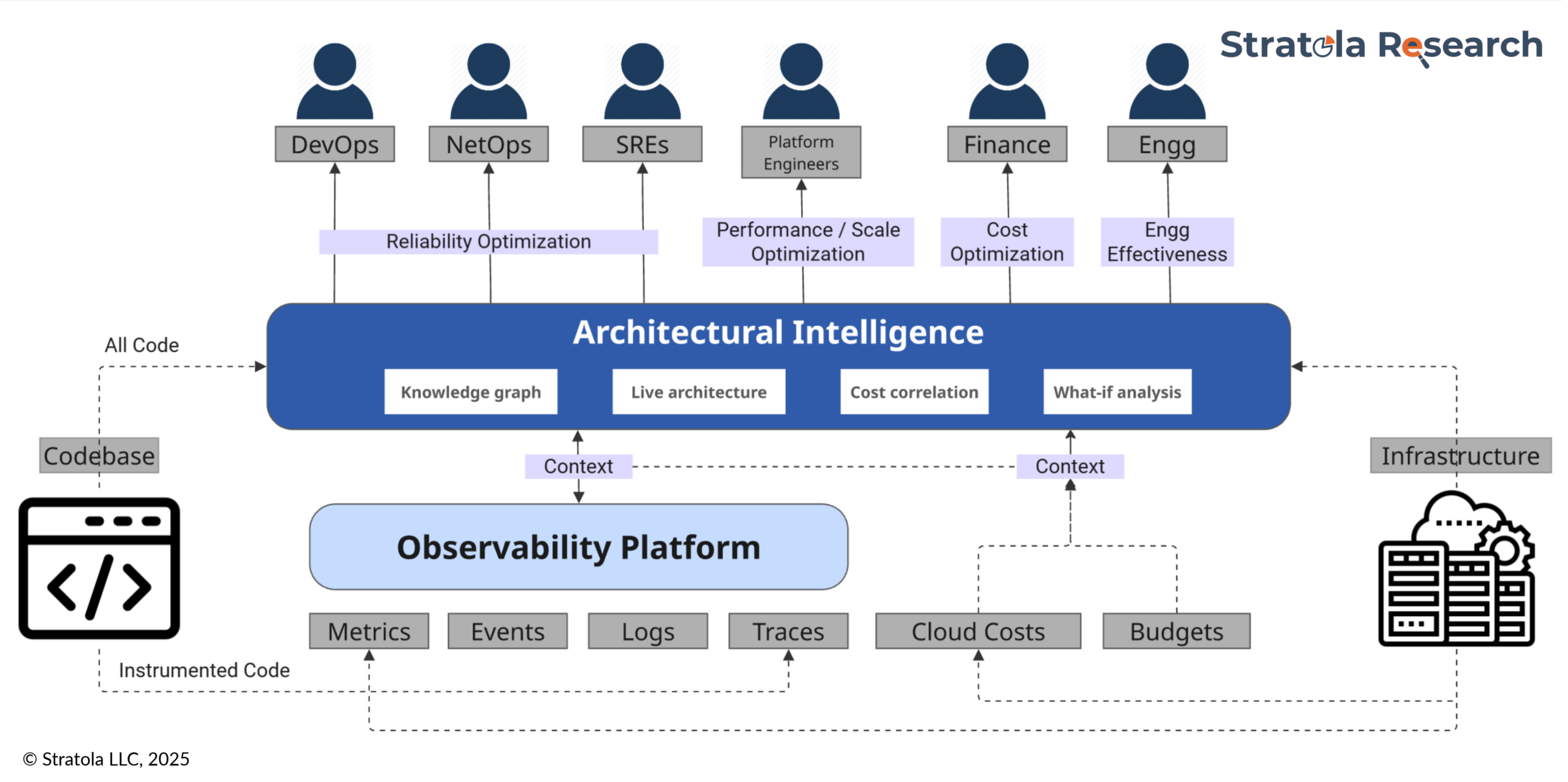
In the previous article, we examined why Observability alone is no longer sufficient and how AI-driven architectural knowledge can unlock a unified, organization-wide view of complex systems. In this post, we will take a deeper look into Architectural Intelligence and the core capabilities that make it truly transformative.
Architectural Intelligence is a unified semantic layer that connects code, infrastructure, and organizational context into one continuously evolving model. It automatically translates your code and configurations into living architecture diagrams, enriched with real-time overlays of cost, dependencies, and service flows. Instead of static documentation that quickly becomes obsolete, it creates a living representation of how your systems actually work. This shared model becomes the common language across engineering, FinOps, Product, and leadership teams by helping them see the same picture, discuss trade-offs with context, and make faster, smarter decisions. In short, Architectural Intelligence turns complexity into clarity and visibility into alignment.
For a deep dive on Architectural Intelligence, refer to this paper: “Architectural Intelligence – A New Paradigm for Enterprise Visibility in the AI Era” by independent research analyst firm Stratola, which provides a deep examination of why traditional cloud cost-optimization approaches are failing in the AI era. It offers a research-backed perspective on aligning engineering, FinOps, and leadership through architectural and contextual intelligence.
JigsawML’s Architectural Intelligence
Architecture is no longer a static artifact. It is the living, continuously evolving model of the enterprise. And when that model isn’t captured or shared, organizations inevitably accumulate tech debt, experience architectural drift, and struggle to make changes quickly or confidently.
But when everyone from engineers to product leaders to executives can sit at the table with the same accurate, real-time picture of the system, everything changes. Decisions become faster. Risks become visible. Alignment becomes natural.
This is exactly why we built JigsawML. And this vision has been reinforced by the hundreds of conversations we have had with our customers.
In the Architectural Intelligence space, we offer five foundational capabilities designed to bring this living architecture to life.
1. Automated architecture diagrams with zero instrumentation
JigsawML’s Architecture Intelligence scans code repositories and generates an always-current view of the enterprise architecture. Zero instrumentation and zero agents. By this, you will be able to get a live diagram that is used in production instantly.
Assume a new microservice is introduced to handle customer authentication, JigsawML can automatically detect the new endpoint by reading from the code base directly, and it can identify its dependencies (like database or caching layers), and update the system diagram instantly. Engineers no longer need to chase stale documentation or redraw Visio charts. With JigsawML, the architecture always reflects reality.
2. Automated cloud Infrastructure diagrams
Connect JigsawML directly to your cloud environments like AWS, Azure, or GCP (coming soon) and, in one shot, generate complete, contextual cloud architecture diagrams.
JigsawML automatically discovers compute instances, load balancers, storage, networking configurations, and application services, then renders them into an architectural blueprint. Unlike traditional infrastructure-as-code visualization tools that only represent what’s deployed, JigsawML connects what’s deployed to why it exists, thereby bridging the gap between architecture and intent.
For cloud architects, this means they can finally visualize multi-cloud dependencies and cross-region data flows without juggling three different dashboards.
3. Living knowledge graphs
At the core, JigsawML is a living knowledge graph, a dynamic, interconnected model that captures how systems, data, and people relate to each other.
This relational intelligence allows teams to ask complex questions in seconds:
- Which services depend on this deprecated API?
- What’s the blast radius if we change this database schema?
- Who owns the service driving our latest cost spike?
For Cloud Architects, Engineering Managers and the leadership teams, these insights could radically transform their troubleshooting from reactive fire-fighting to informed decision-making.
4. Multi-dimensional attribution
JigsawML overlays cost, performance, and reliability metrics directly on the architectural map. Every node in the system, whether it’s a service, database, or compute instance, carries multi-dimensional attributes: utilization, latency, spend, and uptime. This means teams can see not only how systems are performing, but also what that performance costs.
When evaluating a high-latency microservice, engineers can see that adding more replicas would improve performance by 20% but increase monthly compute spend by $3,000. The FinOps team, viewing the same data, can model whether that spend aligns with business value. By linking metrics to architecture, JigsawML enables data-driven trade-off decisions between speed, reliability, and cost, turning raw telemetry into architectural intelligence.
5. Human-centered AI assistance
While JigsawML uses machine learning to detect anomalies, surface correlations, and suggest optimizations, it keeps humans firmly in control.
JigsawML’s recommendations are context-aware and are not generic alerts. The insights that JigsawML generates are framed around architectural intent. It identifies patterns that might otherwise go unnoticed, such as:
- A data transfer cost spike caused by inter-region API calls
- A GPU cluster running at low utilization after model retraining
- A security group exposing unnecessary network paths
JigsawML might detect that Service A communicates frequently with Service B across zones, suggesting co-location to save $1,200 per month in data transfer costs. The system surfaces the recommendation, shows historical usage data, and explains architectural implications, helping humans make confident, context-rich decisions.
JigsawML does not just automate actions, but it also presents these findings in natural language, showing the reasoning behind the recommendation. Engineers and FinOps practitioners evaluate options and apply their judgment to choose the right trade-off.
The Outcome: Architecture as a living system
Together, these capabilities redefine how organizations perceive and manage cloud architecture. What once demanded weeks of diagramming, manual audits, and cross-functional alignment now happens continuously, contextually, and collaboratively. JigsawML transforms architecture from a static artifact into a living system of record where cost, performance, and ownership converge into a single, dynamic model that reflects reality in real time. This continuous synchronization enables every decision, from scaling infrastructure to optimizing spend, to be made with full architectural and financial context.
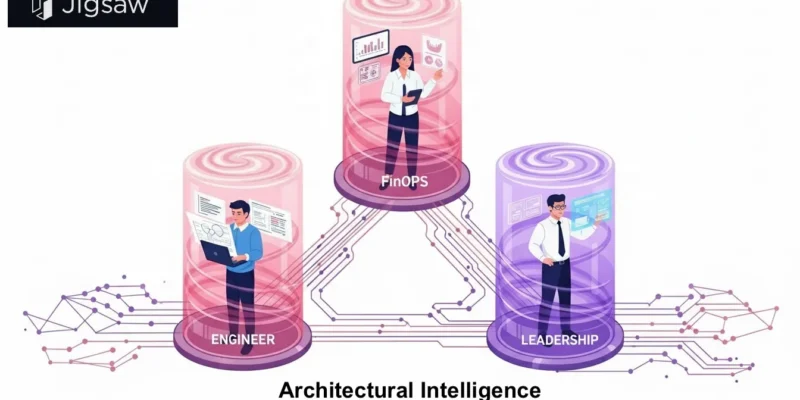
Building on this foundation, JigsawML extends this intelligence into a shared mental model that unites the entire organization. Engineers, Architects, Engineering Managers, Cloud Architects, FinOps Analysts, and VPs can all view and discuss the same architectural truth through their own lens, but grounded in one consistent source of context. This shared model breaks down silos, allowing technical and business leaders to speak a common language about systems, costs, and trade-offs. With automated discovery, living knowledge graphs, and human-centered insights, JigsawML enables teams to move beyond fragmented visibility into having a thorough architectural understanding, thereby creating the true foundation for sustainable cloud cost optimization in the AI era.

Leave a Reply